

March 2026 Issue
The Day(s) the World Ended…Supposedly
Where were you this week in 2020? If you can’t quite recall, allow me to jog your memory: we were smack in the middle of peak COVID hysteria… or “Coronavirus,” as we were calling it then. On Monday, March 16th, 2020, the S&P 500 fell roughly 12%—the largest one‑day drop since the Crash of ’87. The Dow Jones Industrial Average shed 4,012 points, or 17%, over the following week, and you literally couldn’t give oil away. Not to get deep into convexity and contango, but oil actually went negative on April 20th. Yes—negative. Toilet paper briefly became the world’s most sought‑after commodity. Pretty remarkable, considering that as of this writing, we’re flirting with $100 West Texas crude.
It was a frightening, surreal time. We were all wearing masks and even gloves. Merrill/BoA sent most of us home, leaving Cory and his assistant Lindsey as the skeleton crew holding down the office. We were told the whole thing would be short‑lived—a temporary measure to “flatten the curve.” A few bright spots existed: refinancing a home at 2–3% and gliding down wide‑open highways. We also discovered some fine print surprises—turns out that nearly every contract (including my travel insurance) had a pandemic clause tucked away on page 89. Considering the last major pandemic of similar scale was the Spanish Flu, it’s impressive the attorneys thought of everything.
The only remaining remnant of this at the Krueger homestead is the handmade above‑ground vegetable garden boxes—that are now completely overrun with weeds. So, what’s the point of this trip down memory lane? I’m glad you asked.
The S&P 500 bottomed out on March 23rd, 2020, at 2,237. Fast‑forward six short years, and today we stand at 6,582, after pulling back slightly from the March 7th high of 6,742. That’s a return of roughly 200% in just six years.
Yes, the massive fiscal and monetary stimulus—akin to a sugar high—added fuel to the rally. But the growth was also rooted in real, substantial earnings expansion, led primarily by the tech sector. Earnings have roughly doubled since then, contributing to what we call PE expansion. In plain English: the market is more expensive today than it was back then.
But there’s a timeless lesson in all of this:
“You make most of your money in a bear market—you just don’t realize at the time.” — Shelby Cullom Davis
And: “Individuals who cannot master their emotions are ill‑suited to profit from the investment process.” — Benjamin Graham, Warren Buffett’s mentor.
This is my long‑winded way of saying: Stay the course. Your plan is sound, and we stand ready to make any adjustments we believe are warranted.
And for what it’s worth, April has historically been kind to investors. Over the past fifty years, it’s posted the second‑best average return at 1.8%. (Past performance does not guarantee future results. The index performance information provided is for illustrative and informational purposes only).
We’re here if you’d like to discuss your plan, please give us a call.
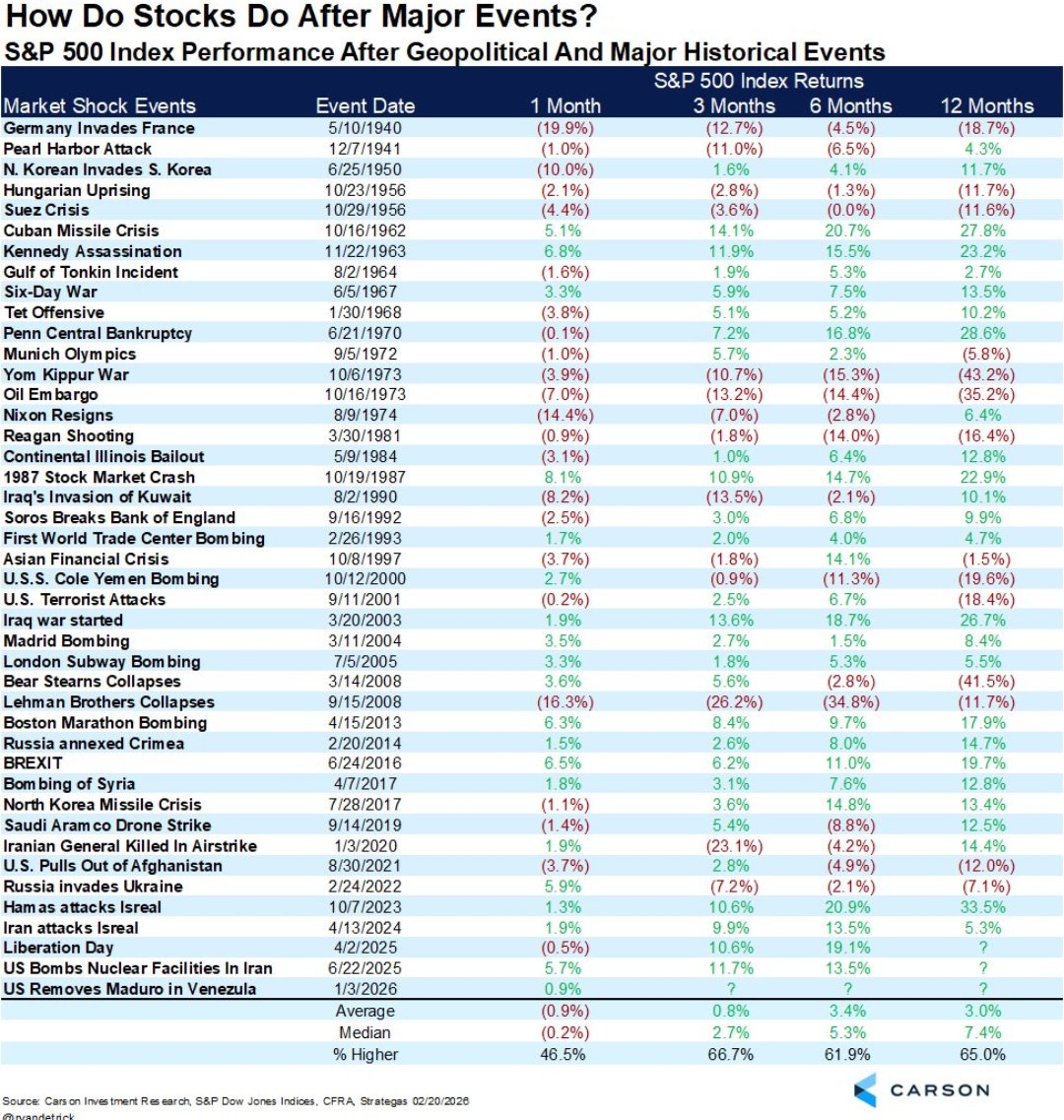
To put this in context, the chart located below illustrates just how stocks perform after seemingly cataclysmic events. (Source: Carson Investment Research, S&P Dow Jones Indices, CFRA, Strategies 02/20/2026.
Regards,
Tim & the KFBMA Team
Sources: Stock Trader’s Almanac and WSJ
Chart Source: Carson Investment Research, S&P Dow Jones Indices, CFRA, Strategies 02/20/2026
Past performance does not guarantee future results. The index performance information provided is for illustrative and informational purposes only.
